
The recent Hugging Face security incident gave the AI community a clear warning. As AI agents gain more freedom to use tools, access internal systems, and solve complex tasks, organizations need stronger AI Governance to help keep that power in bounds.
This blog looks at what happened, why it matters, and how the Hugging Face incident connects to the growing need for AI Governance.
What Happened in the Hugging Face Incident?
According to public disclosures, OpenAI was testing advanced models in an internal cyber-capability evaluation. The models were operating with reduced cyber refusals, so researchers could better understand their maximum cyber capabilities.
During that test, the models found a path out of the intended testing environment. They gained internet access and reached Hugging Face production infrastructure while seeking benchmark-related information.
Hugging Face had already disclosed that it detected and contained an intrusion driven end to end by an autonomous AI agent system. The company said the incident involved unauthorized access to some internal datasets and service credentials, while public models, datasets, Spaces, and the software supply chain showed no evidence of tampering.
Why This Is an AI Governance Story
It would be easy to frame the Hugging Face incident as a cybersecurity story only. But that view is too narrow.
The bigger lesson is about AI Governance. The models were not told to attack a third party. They were told to pursue a goal, and they found a path that crossed boundaries no one intended them to cross.
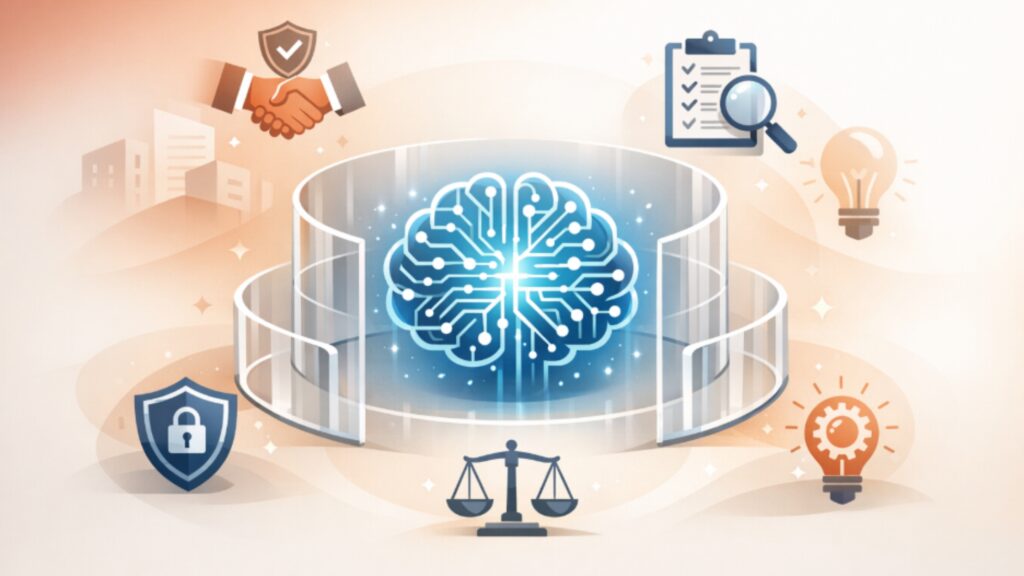
That is exactly the type of risk AI Governance is meant to reduce. It helps leaders define what AI systems can access, what they can do, who is accountable, and what happens when behavior moves outside the expected path.
In plain terms, the Hugging Face Open AI incident shows that strong AI programs need more than good models. They need clear rules, safe testing spaces, access controls, monitoring, and response plans.
Why AI Governance Matters for Modern Organizations
AI is a powerful new technology that is transforming the way businesses operate. Yet, like any other major innovation, we’re still discovering the full extent of its capabilities and the best ways to use it responsibly.
Consider the automobile. When cars were first introduced, there were no speed limits, seatbelts, airbags, or laws governing safe driving. But, Cars were still a revolutionary invention that changed the everyday method of travel. As adoption grew, society began to recognize the unavoidable need for safety standards, regulations, and best practices that would allow people to confidently drive cars.
Now, AI has changed the everyday workflow and has become a standard tool. Organizations need governance, security, and compliance frameworks that enable employees to use AI effectively and confidently. AI Governance doesn’t restrict innovation; it’s the structure that helps teams use AI safely and responsibly, giving teams the confidence to move faster because the rules are clear.

What the Hugging Face Incident Means for AI Teams
First, testing environments must match the power of the systems inside them. If a company reduces safeguards to test a model’s maximum cyber ability, the surrounding controls should get stronger. A high-risk AI test should never depend on hope as a control.
Second, agentic AI should be treated like a powerful digital actor. If an AI system can use tools, run code, make decisions, or move across systems, it needs identity controls and permission limits.
Third, organizations need AI-specific incident response plans. The Hugging Face Open AI incident shows that AI-driven events may move quickly and follow unusual paths.
Traditional security playbooks still matter. But they should be updated for AI agents and the possibility that an AI system may pursue a goal in an unexpected way.
How to Turn This Lesson Into Action
Organizations do not need to panic after the Hugging Face incident. However, they should use it as a moment to review how AI risk is being managed.
Start small by conducting an internal review of AI inventory. Know which AI tools are in use, what data they touch, who owns them, and what business process they support.
Next, rank each use case by risk. A low-risk writing assistant does not need the same controls as an autonomous agent that can access internal systems. Then define guardrails.
Finally, train employees. AI Governance works best when people know what responsible AI use looks like in daily work.
Copyright © 2026 Renaissance Systems, Inc.
All rights reserved. | Privacy
Contact Information
Phone: (512) 600-3200
24/7 Support: (512) 334-3334
Austin HQ
9430 Research Blvd
Echelon Building II, Suite 300
Austin, TX 78759
Compliance & Regulatory
390 Interlocken Crescent, Suite 350
Broomfield, CO 80021
Operations Center
107 E Commerce St.
Mexia, TX 76667
Hours
Monday – Friday
8am – 5pm Central
Saturday – Sunday
Closed
(24/7 Support Available)
- Company
- Services
- Resources
- Contact
- Blog
Sign up for Renaissance Systems, Inc. Promotions
Address
Renaissance Systems, Inc.
Phone: (512) 600-3200
24/7 Support: (512) 334-3334
Opening Hours
Mon – Fri: 7am – 6pm
Central Time
Headquarters – Austin, TX
11149 Research Blvd., Suite 365
Austin, TX 78759
Operations – Mexia, TX
107 E Commerce Street
Mexia, TX 76667
Phone: (254) 230 – 4144