
For years, businesses worried about hackers stealing data. Today, many organizations face a different challenge: employees accidentally exposing it.
Today, many data problems start with normal employee actions. A team member may paste a client list into an AI tool, upload a proposal for editing, or share a chat link with a coworker.
Employees may upload proposals, customer lists, financial information, internal procedures, contracts, or operational data simply to get help from an AI assistant. In many cases, their intent is innocent, they are trying to work faster and be more productive. The problem is that productivity tools evolve much faster than company policies.
This is why AI data exposure risks for small businesses need simple rules, not just technical controls.
What the Claude Search Incident Taught Business Owners
The Claude incident showed how confusing “share with a link” can be. Many people think a link is private because only people with the link can open it.
In practice, a public link can be copied, posted, indexed, archived, or found later. If that link contains customer data, financial details, resumes, API keys, contracts, or internal notes, the damage can spread fast.
This matters because small businesses often rely on trust. A single data exposure can hurt customer confidence, create legal questions, and distract leaders from growth.
The lesson is simple: if content is shared publicly, treat it as public. That rule applies to AI tools, cloud drives, collaboration apps, and social media.
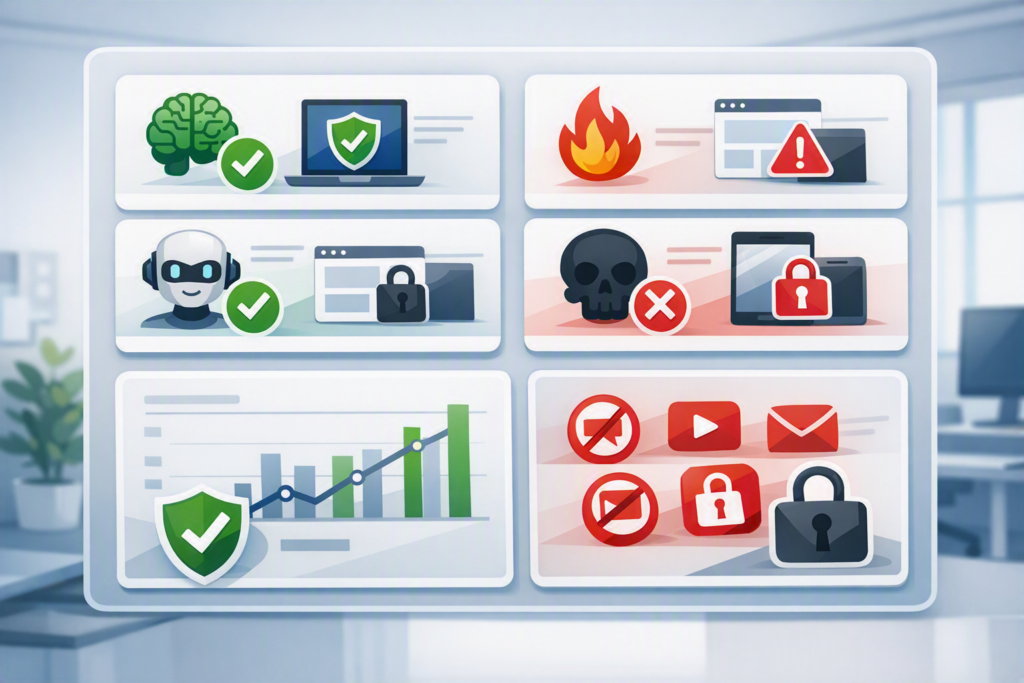
Why AI Data Exposure Risks Are Rising
AI tools are now part of everyday work. Employees use them to write emails, summarize notes, review documents, and move faster.
That speed is useful, but it also creates a new risk. AI data exposure risks for small businesses are growing because one shared chat, file, or link can turn private information into public information.
Last week, reports surfaced that shared conversations from Anthropic’ s Claude AI assistant were appearing in Google search results, exposing everything from business documents and resumes to medical information and internal company details. While the affected chats had been shared using public links, many users were surprised to discover just how easily that information could become searchable on the internet.
Start With Five Simple AI Data Rules
The good news is yfou do not need a massive governance program on day one. Start with a short list of rules that every employee can understand.
- Never enter customer, employee, financial, health, legal, or confidential business data into an AI tool unless it’s pre-approved.
- Assume anything shared with a public link could become searchable.
- Review sharing settings before sending links outside the company.
- Use only company-approved AI tools for business work.
- When in doubt, ask before uploading or pasting sensitive information.
These five rules alone can dramatically reduce AI data exposure risks for small businesses without slowing tasks down. And they are easy to teach.

Start Implementing Basic AI Rules Today
As your organization matures, you can build on your foundation with formal policies, AI governance standards, employee training, and technology controls. But waiting for the “perfect” program is a mistake. Simple guidance implemented today is far more effective than a comprehensive policy that never gets adopted.
As cybersecurity professionals, we often see small business owners assume they are too small to be targeted or affected. In reality, most data exposures are not caused by sophisticated attacks. They are caused by everyday decisions made by well-meaning employees who do not understand the risks.
The organizations that will succeed in the AI era will not be the ones that avoid innovative technology. They will be the ones that embrace it responsibly.
The Claude incident serves as a reminder that the line between private and public is becoming thinner every year. A little awareness, a few clear rules, and ongoing education can go a long way toward keeping your business’s information where it belongs inside your business.
Build a Formal AI Acceptable Use Policy Over Time
Once your basic rules are in place, build a simple AI acceptable use policy. This policy should explain which tools are approved, what data is off limits, and who employees should ask for help.
It should also explain how AI-generated content must be reviewed. AI can make mistakes, so employees should check facts, tone, privacy, and accuracy before using AI output in business work.
A good policy does not have to be long. It should be clear, practical, and easy to follow.
Train Employees Before There Is a Problem
Training is where policy becomes habit. Employees need short, repeated reminders about what not to upload, what public sharing means, and when to ask for approval.
Use real examples. Show how a harmless-looking shared link can expose private business details. Subscribe your employees to a weekly cybersecurity awareness newsletter.
Keep the message simple. If employees remember only one idea, it should be this: do NOT put sensitive business information into tools that are not approved.
Use Approved Tools and Technical Guardrails
Cybersecurity awareness training and rules are important, but tools matter too. Approved AI platforms should match your business needs and your data protection standards.
Where possible, use single sign-on, MFA, access controls, data loss prevention, logging, and admin settings. These controls make it easier to guide safe behavior.
You should also review browser extensions, meeting bots, and unofficial AI apps. These tools can create shadow AI risk because they may access company data without review.
How to Respond if Data Was Shared Publicly
If your team finds that business data was shared publicly, act quickly. Remove the shared link, revoke access, and document what was exposed.
Next, decide whether customers, vendors, legal counsel, or regulators need to be notified. Do not guess. Follow your incident response plan or ask a qualified advisor.
Finally, use the event as a learning moment. Update your AI rules, improve training, and check whether other shared links or tools need review.
Final Thoughts
The takeaway: Do not wait for AI data exposure to create employee guidance. Start with simple rules, educate your team, and build your program one step at a time. Your future self will thank you.
AI is not the enemy. Unclear sharing, unmanaged tools, and rushed decisions are the real problem.
Start with five rules. Train your team. Review your tools. Then build a stronger program step by step.
That small effort can help keep your company’s information where it belongs: inside your business.
Copyright © 2026 Renaissance Systems, Inc.
All rights reserved. | Privacy
Contact Information
Phone: (512) 600-3200
24/7 Support: (512) 334-3334
Austin HQ
9430 Research Blvd
Echelon Building II, Suite 300
Austin, TX 78759
Compliance & Regulatory
390 Interlocken Crescent, Suite 350
Broomfield, CO 80021
Operations Center
107 E Commerce St.
Mexia, TX 76667
Hours
Monday – Friday
8am – 5pm Central
Saturday – Sunday
Closed
(24/7 Support Available)
- Company
- Services
- Resources
- Contact
- Blog
Sign up for Renaissance Systems, Inc. Promotions
Address
Renaissance Systems, Inc.
Phone: (512) 600-3200
24/7 Support: (512) 334-3334
Opening Hours
Mon – Fri: 7am – 6pm
Central Time
Headquarters – Austin, TX
11149 Research Blvd., Suite 365
Austin, TX 78759
Operations – Mexia, TX
107 E Commerce Street
Mexia, TX 76667
Phone: (254) 230 – 4144