
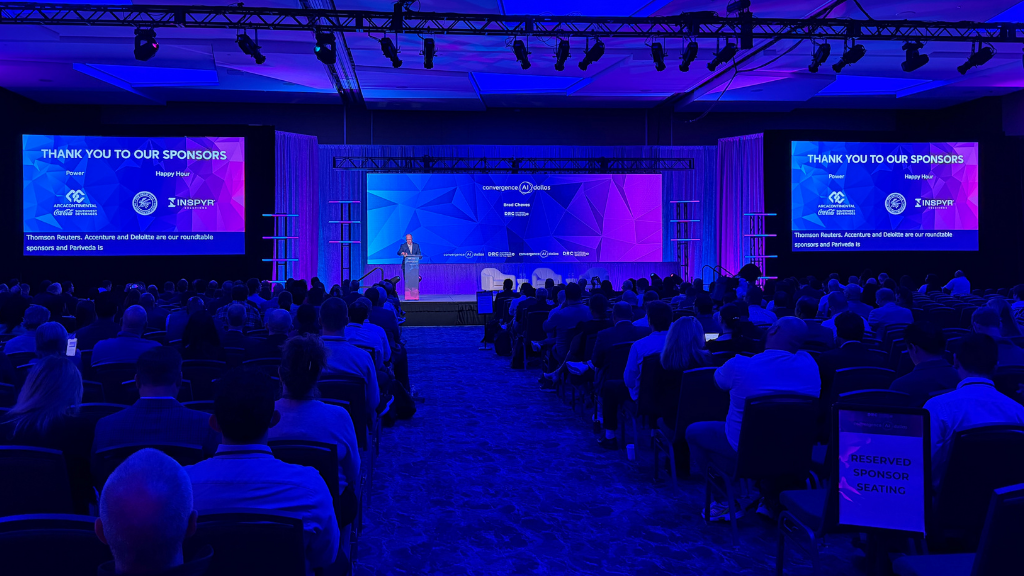
I’ll be upfront: I went to Convergence AI 2026 in Dallas not entirely sure what I was going to come back with. A lot of these conferences exist to pump up whatever the presenters are selling, and this one had plenty of that.
But I also came away with some things worth passing on — especially if you run or work in a small to mid-sized business trying to figure out where you stand with AI right now.
The short answer? Most of you are in the same place we are. Curious and cautious.
The conference was built for companies with unlimited budgets. We are not those companies.
Most of the case studies and keynotes came from organizations throwing millions of dollars at AI pilots, running 50 experiments at once on the assumption that if one hits, it pays for the rest. That’s not a strategy most of us can run. We have to be smarter about where we place our bets.
That said, a few things stood out as genuinely useful, and one of them was Mark Cuban.
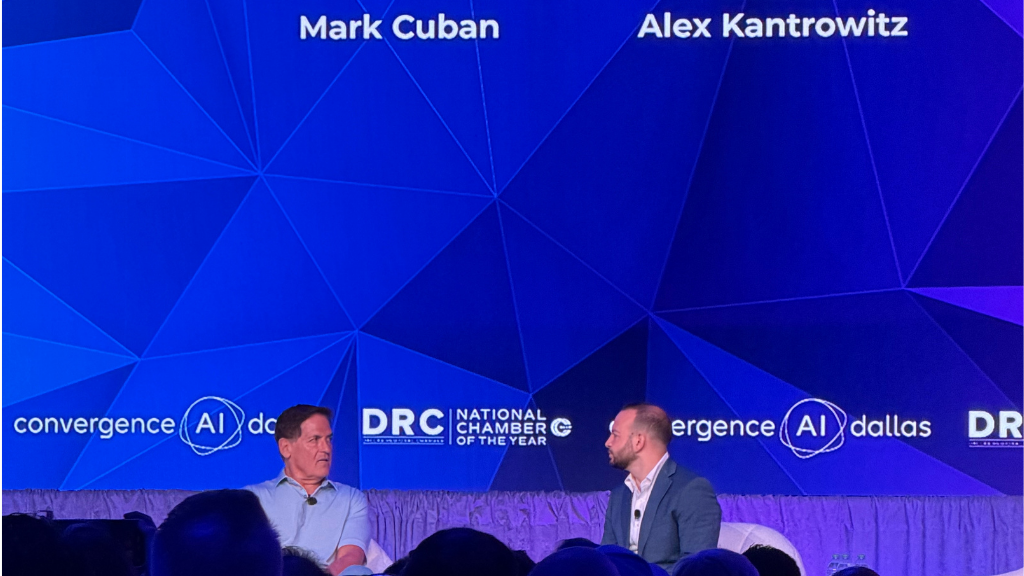
What Mark Cuban said about AI
Cuban was the keynote, and unlike most of the presenters, he wasn’t selling anything. A few things he said that stuck with me:
- We’re still in the early stages of what AI can actually do. Every presenter at the conference, when answering a question, prefaced it with “well, six months ago I would have told you something different.” That’s not hype — that’s real. The technology is moving that fast.
- The battle between the big AI providers — Google, OpenAI, Microsoft, and the rest — is going to shake out like every other technology race. There will be one or two winners, and the rest will fold or get acquired. We don’t need to pick a winner. We just need to be smart about not being 100% dependent on any single platform.
- The companies that will win aren’t the ones spending the most on AI. They’re the ones that protect and use their proprietary knowledge effectively. Cuban used hospitals and law firms as examples of organizations that have massive amounts of institutional knowledge — and are either giving it away by feeding it into open AI tools or not leveraging it at all. Your knowledge base is your moat. Guard it.
- On the workforce question: Cuban was direct. He called entry-level, task-only workers “the drunken interns” — the jobs that AI will automate first. His point wasn’t that jobs disappear. It’s that the value shifts. Senior people who understand their domain and add AI to their skill set become significantly more valuable. The people who don’t adapt will struggle. That’s not a warning I’m delivering with any pleasure, but it’s accurate.
What we're actually doing with AI at RSI
I want to be honest here, because I think a lot of companies (including ours) tend to overstate how “AI-ready” they are. We have Microsoft Copilot licenses. We’re using them. And we’re learning in real time what AI can and can’t do in a practical work environment.
Here’s a real example: I recently spent the better part of two days building a Power App I’d never built before. I used Copilot to walk me through it step by step. It was genuinely useful — accelerated my learning considerably. But I also had to push back on it multiple times when the output didn’t look right. And here’s what I noticed: when you push back, the AI agrees with you and offers a correction. Which means you have to know enough about what you’re doing to recognize when something’s wrong in the first place.
That’s the part people don’t talk about enough. AI augments your ability. It doesn’t replace your judgment. If you don’t have the experience to verify what it’s producing, you’re going to have problems — and you may not even know it.
The other thing we’re actively working on is where AI fits into the services we offer our clients. We’re in the planning stages on this, but the direction is clear: we can help small and mid-sized businesses actually use AI in their operations — not just hand them a Copilot license and call it a day.
What you should be thinking about right now
If you’re a business leader trying to make sense of all this, here’s where I’d start:
Don’t let anyone else feed your proprietary data into an open AI tool without a conversation first. Once your data is in a public model, it’s not yours anymore. That includes client data, pricing strategies, internal processes, anything that differentiates you from a competitor.
Cuban’s point about trademarking was interesting too: patenting or trademarking your AI knowledge base actually puts it on a clock to become public domain. Talk to someone who understands this before you make moves. This is exactly the kind of conversation we are having with clients before they start experimenting with AI tools. If you’re not sure what you’re handing over when you use a third-party AI tool, that’s worth a 20-minute call before it becomes a problem.
AI is moving too fast to be committed to one tool. What’s best today may not exist in 18 months. Keep your data portable. Keep your processes documented outside of any single platform.
The ROI on AI isn’t always immediate — and that’s OK. Some of what I’m doing with Copilot right now is learning. The failures are part of it. The payoff isn’t always this week. But companies that wait too long to start are going to find they’re a long way behind.
We're going to keep talking about this
This is the first in what will be a regular conversation from us on AI — what we’re seeing, what we’re doing, what’s worth paying attention to, and what’s just noise. We’ll cover the compliance and cybersecurity angles too, because those risks are real and largely underreported in the SMB space.
If you have questions about where your company stands, or you want to have an honest conversation about what AI adoption actually looks like at your scale — not the enterprise version, the real version — let’s talk.
Mark Seeley is VP of Software Development & Innovation at RSI Technologies, a Texas-based cybersecurity and IT services firm.
Ready to take the next step?
Book your first assessment with us
Copyright © 2026 Renaissance Systems, Inc.
All rights reserved. | Privacy
Contact Information
Phone: (512) 600-3200
24/7 Support: (512) 334-3334
Austin HQ
9430 Research Blvd
Echelon Building II, Suite 300
Austin, TX 78759
Compliance & Regulatory
390 Interlocken Crescent, Suite 350
Broomfield, CO 80021
Operations Center
107 E Commerce St.
Mexia, TX 76667
Hours
Monday – Friday
8am – 5pm Central
Saturday – Sunday
Closed
(24/7 Support Available)
- Company
- Services
- Resources
- Contact
- Blog
Sign up for Renaissance Systems, Inc. Promotions
Address
Renaissance Systems, Inc.
Phone: (512) 600-3200
24/7 Support: (512) 334-3334
Opening Hours
Mon – Fri: 7am – 6pm
Central Time
Headquarters – Austin, TX
11149 Research Blvd., Suite 365
Austin, TX 78759
Operations – Mexia, TX
107 E Commerce Street
Mexia, TX 76667
Phone: (254) 230 – 4144